knitr::opts_chunk$set(
echo = TRUE,
message = FALSE,
warning = FALSE
)
library(ISLR)
library(tidyverse)
library(caTools)
library(caret)
library(pROC)6 Wages HW
6.1 Introduction
In this assignment, I worked as a data scientist for the Wage Analytics Division (WAD). I was tasked with determining which demographic and employment characteristics predicted whether a worker earned a high wage or low wage.
6.2 Loading Libraries
6.3 Create the Wage Category Variable
data("Wage")
median_wage <- median(Wage$wage, na.rm = TRUE)
Wage$WageCategory <- ifelse(Wage$wage > median_wage,
                            "High",
                            "Low")
Wage$WageCategory <- factor(Wage$WageCategory,
levels = c("Low", "High"))table(Wage$WageCategory)
 Low High
1517 1483
6.4 Data Cleaning
categ_vars <- c("maritl", "race", "education", "region",
              "jobclass", "health", "health_ins")

Wage[categ_vars] <- lapply(Wage[categ_vars], function(x)
  factor(gsub("^[0-9]+\\.\\s*", "", x))
)
6.5 Classical Statistics Tests
tt_age <- t.test(age ~ WageCategory, data = Wage)
print(tt_age)
    Welch Two Sample t-test

data:  age by WageCategory
t = -10.888, df = 2855, p-value < 2.2e-16
alternative hypothesis: true difference in means between group Low and group High is not equal to 0
95 percent confidence interval:
 -5.298535 -3.681416
sample estimates:
 mean in group Low mean in group High
          40.19512           44.68510
An independent-samples t-test compared the mean age of high wage earners (44.69 years) and low wage earners (40.20). The difference was statistically significant, t(2855) = -10.888, p < .001.
anova_job <- aov(wage ~ jobclass, data = Wage)
summary(anova_job)
Df Sum Sq Mean Sq F value Pr(>F)
jobclass 1 223538 223538 134.1 <2e-16 ***
Residuals 2998 4998547 1667
---
Signif. codes: 0 '***' 0.001 '**' 0.01 '*' 0.05 '.' 0.1 ' ' 1A one-way ANOVA was conducted to examine whether mean wage differs by job class. The analysis showed a significant effect of job class on wage, F(1, 2998) = 134.1, p < .001.
contingtabmarit <- table(Wage$maritl,Wage$WageCategory)
contingtabmarit
                 Low High
  Divorced       118   86
  Married        872 1202
  Never Married  479  169
  Separated       37   18
  Widowed         11    8
chitest <- chisq.test(contingtabmarit)
chitest
    Pearson's Chi-squared test

data:  contingtabmarit
X-squared = 212.51, df = 4, p-value < 2.2e-16
A Chi-square test of independence was conducted to examine whether marital status is associated with wage category. The test showed a significant relationship between the two variables, χ²(4) = 212.51, p < .001. In general, far more high wage earners seem to be married.
Note
This association may be due to the fact that the psychological/financial benefits of marriage allow individuals to invest more energy into their work. But, this theory is merely speculative.
n <- sum(contingtabmarit)
chi_sq <- as.numeric(chitest$statistic)
r <- nrow(contingtabmarit)
c <- ncol(contingtabmarit)

cramers_v <- sqrt(chi_sq / (n * (min(r - 1, c - 1))))
cramers_v
[1] 0.2661507Cramer’s V is .27, meaning that the effect size of the association between marital status and wage is small.
6.6 Logistic Regression Model
set.seed(42)
split <- sample.split(Wage$WageCategory, SplitRatio = 0.7)

training <- subset(Wage, split == TRUE)
testing  <- subset(Wage, split == FALSE)

log_model <- glm(
  WageCategory ~ age + maritl + education + health,
  data = training,
  family = binomial
)

summary(log_model)
Call:
glm(formula = WageCategory ~ age + maritl + education + health,
    family = binomial, data = training)

Coefficients:
                          Estimate Std. Error z value Pr(>|z|)
(Intercept)              -3.255861   0.373442  -8.719  < 2e-16 ***
age                       0.022625   0.004982   4.541 5.59e-06 ***
maritlMarried             0.820208   0.194407   4.219 2.45e-05 ***
maritlNever Married      -0.416023   0.228951  -1.817  0.06920 .
maritlSeparated           0.366011   0.426568   0.858  0.39087
maritlWidowed             0.613146   0.622860   0.984  0.32492
educationAdvanced Degree  3.052436   0.250998  12.161  < 2e-16 ***
educationCollege Grad     2.200286   0.219710  10.015  < 2e-16 ***
educationHS Grad          0.726159   0.211044   3.441  0.00058 ***
educationSome College     1.518352   0.217545   6.979 2.96e-12 ***
health>=Very Good         0.367377   0.113967   3.224  0.00127 **
---
Signif. codes:  0 '***' 0.001 '**' 0.01 '*' 0.05 '.' 0.1 ' ' 1

(Dispersion parameter for binomial family taken to be 1)

    Null deviance: 2910.9  on 2099  degrees of freedom
Residual deviance: 2352.7  on 2089  degrees of freedom
AIC: 2374.7

Number of Fisher Scoring iterations: 4exp(coef(log_model)) (Intercept) age maritlMarried
0.03854761 1.02288254 2.27097152
maritlNever Married maritlSeparated maritlWidowed
0.65966539 1.44197133 1.84622959
educationAdvanced Degree educationCollege Grad educationHS Grad
21.16684800 9.02759400 2.06712472
educationSome College health>=Very Good
4.56469549 1.44394229 The logistic regression revealed a variety of significant predictors of wage. Age, “married” marriage status, and all levels of education were significant. Very good health was also a significant predictor. The predictor with the largest effect size was “advanced degree” (OR = 21.7). This was followed by “college grad” (OR = 9.03) and “some college” (OR = 4.6). The OR did not exceed 3 for any of the other predictors. As a result, we can conclude that higher education, in general, is the most meaningful predictor of wages. The most surprising aspect of this result is the fact that “some college” is such a strong predictor. It is unclear whether this category refers to individuals who completed some college then dropped out, or individuals who completed associate’s degrees or followed related, less standard college pathways.
6.7 Model Evaluation on Test Data
pred_probs <- predict(log_model, newdata = testing, type = "response")
pred_class <- ifelse(pred_probs > 0.5, "High", "Low")
pred_class <- factor(pred_class, levels = c("Low", "High"))
conf_mat <- confusionMatrix(pred_class, testing$WageCategory, positive = "High")
conf_mat
Confusion Matrix and Statistics
Reference
Prediction Low High
Low 345 156
High 110 289
Accuracy : 0.7044
95% CI : (0.6734, 0.7341)
No Information Rate : 0.5056
P-Value [Acc > NIR] : < 2.2e-16
Kappa : 0.4081
Mcnemar's Test P-Value : 0.005796
Sensitivity : 0.6494
Specificity : 0.7582
Pos Pred Value : 0.7243
Neg Pred Value : 0.6886
Prevalence : 0.4944
Detection Rate : 0.3211
Detection Prevalence : 0.4433
Balanced Accuracy : 0.7038
'Positive' Class : High
roc_obj <- roc(testing$WageCategory, pred_probs)
plot(roc_obj, col = "blue", lwd = 2, main = "ROC Curve")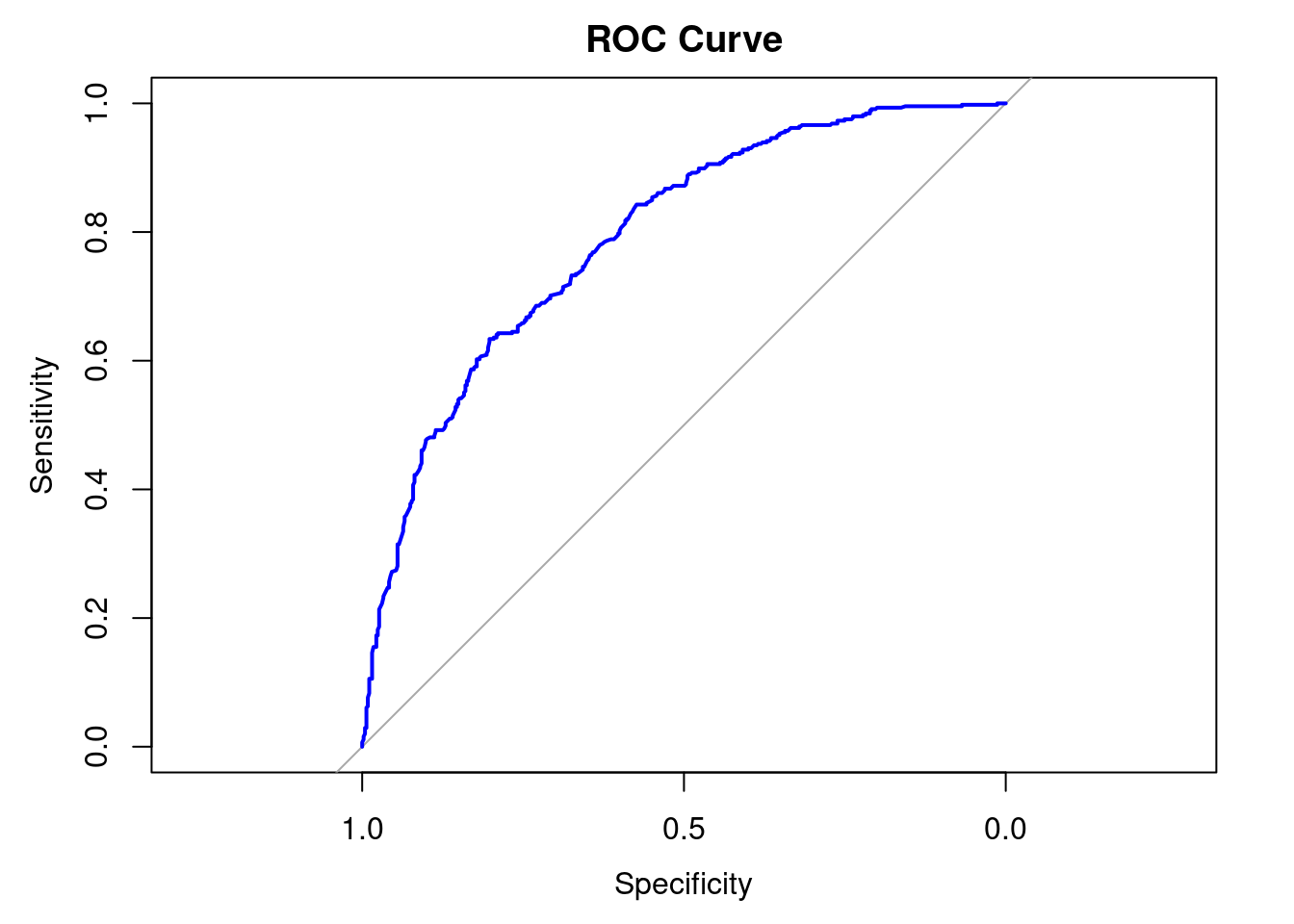
auc_value <- auc(roc_obj)
auc_value
Area under the curve: 0.7909The accuracy of the model was .70, meaning the model was accurate 70% of the time. This is far better than the No Information Rate of roughly 51% (.5056). The sensitivity of the model was .65, meaning that the model accurately identified true high wage earners as high wage earners 65% of the time. The specificity of model was .76, meaning the model accurately identified true low wage earners as low wage earners 76% of the time. The balanced accuracy (the average of the sensitivity and specificity) was .70. The AUC for the ROC is .7909, meaning that the model has good discrimination ability and will accurately discriminate high wage earners from low wage earners around 79% of the time.
6.8 Final Summary
While education, age, and marital status all relate to wage class, education is clearly the most notable predictor. In particular, advanced degrees are very strong predictors - though the two other classes of college-level education are also far stronger than any other predictors. It is unclear how meaningful the relationship of age, overall marital status, and health are to wage status. These three variables are significant, yet their effect sizes are quite small; further research is needed to determine what their relationships to wage status might be.
Overall, my model performed fairly well on unseen data. The accuracy of my model was around 70%, whereas the accuracy of the No Information rate was around 51%. The model, though, identified low wage earners far more accurately than it identified high wage earners. If I were to redo this model, I would remove all the non-significant predictors, since this makes the most sense statistically. If I were looking into a specific question, though (such as the role of education), I might experiment with removing all non-education related variables.